 PA Trace for live sound
How to tune a PA system, step by step
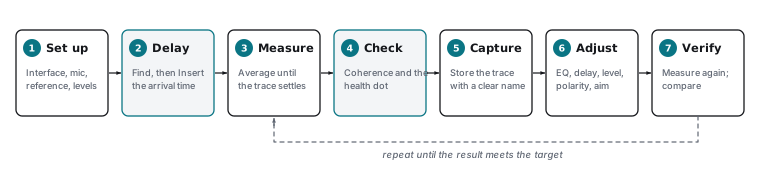
Every system and venue is different, but the order of work is nearly always the same, because each step depends on the ones before it. Tune in this order and you will not spend time EQing a problem that is really a timing problem.
Updated 17 November 2026
The order of work
| Step | Why in this order |
|---|---|
| 1. Verify the system | Every box plays, every driver is in polarity, nothing is swapped. Tuning a fault wastes time. |
| 2. Level and aim | Physical changes come first: they change everything measured after them. |
| 3. Main system delay | Sets the time reference everything else is aligned to. |
| 4. Subwoofers to mains | The crossover between them decides the low end. |
| 5. Fills and delays | Front fills, out fills and delay towers are timed to the mains where they overlap. |
| 6. EQ | Only once the timing is right: a cancellation looks like an EQ problem but is not one. |
| 7. Verify and document | Measure again where the audience is, and keep the evidence. |
1. Verify the system
Play pink noise through one box at a time and listen, then look. The impulse response shows polarity: the main peak of a full-range box should point up. Swept sines expose rattles and damaged drivers. Check that left is left and that every output of the processor feeds what its label says. Details in how to check loudspeaker polarity.
2. Level and aim
Measure the main system at the front, middle and back of its coverage and compare the levels. Aim and splay the boxes for even coverage before you touch EQ: a box pointing at the balcony front cannot be fixed with a filter. An SPL meter helps here, and later during the show.
3. Main system delay
Put the microphone in a good main position, about two thirds of the way back in the coverage, and let the analyzer find the arrival time. This is your time reference. Where several main sources cover the same seats, such as a left and right system, check they arrive together at the center.
4. Subwoofers to mains
Measure subs and mains separately from the same position, with the same time reference, and align them at the crossover with delay and polarity so they add instead of cancelling. The full method is in how to align subs and tops. Then check that the alignment holds at other seats.
5. Fills and delays
For each front fill, out fill or delay tower, put the microphone where it and the main system are about equally loud. Measure each source alone and read its arrival time, then delay the earlier one, usually the fill, by the difference. Measure both together: the comb filtering at the overlap should be gone. Set the air temperature in your analyzer on hot days: on a 15 m delay tower a few degrees make tens of centimeters. The full method is in how to time delay speakers and fills.
6. EQ
Now equalise, with a few rules:
- Measure several positions and average them. One seat includes that seat's reflections and room modes; EQ for it fixes one seat and can spoil others. Three to eight positions across the coverage are typical.
- Only where coherence is high. Low coherence means the curve there is not reliable.
- Broad strokes first. Correct the overall tilt and wide bumps before narrow details.
- Leave cancellations alone. A deep narrow dip that does not respond to EQ is a timing or reflection problem.
- Use a target. A target curve with a tolerance band says when you are done. In PA Trace, Auto PEQ proposes parametric filters for the processor and shows the error before and after; you choose which to use.
The method in full: how to EQ a PA system.
7. Verify and document
Measure again at the positions where the audience will be, and compare with the captures from before the changes. Name every capture with its position and keep them: the next time you return to this venue, or the client asks what was done, you have the evidence. During the show, a transfer function with the console output as reference keeps measuring with the music itself.
Outdoors and in a full room
- Wind makes coherence at the top come and go. Average more, and do not chase it with EQ.
- An audience absorbs high frequencies and shortens the reverberation. Tune the broad shapes before doors open, and refine with the program as reference during the show.
- Temperature changes the speed of sound and every arrival time with it.
New to the measurement itself? Start with transfer function measurement explained.
Related guides
- Polarity check Read polarity in the impulse response and the phase, and why subs and crossovers fool the quick check.
- Delay speakers and fills Measure the arrival of each source where they overlap, delay the earlier one, and check the comb filter is gone.
- How to EQ a PA system Average several seats, compare with a target curve, and set parametric filters only where the seats agree.
- Measurement setup Microphone, interface, where to take the reference, and the levels that make a measurement trustworthy.