 PA Trace for live sound
Transfer function measurement, explained
A transfer function shows what a sound system does to the signal it is given: how much it changes the level of each frequency and how much it delays it. It is the measurement behind almost every system tuning. Here is what it is and how to read it.
Updated 17 November 2026
What a transfer function is
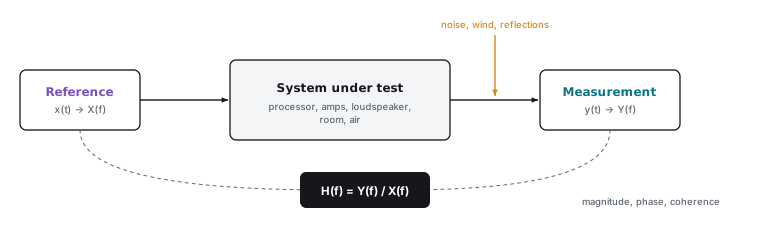
Anything that passes a signal, from a cable to a loudspeaker in a hall, can be described by what it does to each frequency: a change in level (gain) and a shift in time (phase). That description is its transfer function, H(f). If you know the input X and the output Y, then H = Y / X.
In a sound system the input is the reference, the signal sent to the processor or amplifier, and the output is what the measurement microphone hears. A dual-channel analyzer records both, turns them into spectra with an FFT, and divides one by the other. Because the reference is part of the calculation, the test signal does not matter: pink noise, music and speech all give the same transfer function, as long as they contain energy at the frequencies you look at.
Why not just use an RTA?
A real-time analyzer shows the spectrum of what the microphone hears: the loudspeaker, but also the music. Change the song and the curve changes. A transfer function removes the program and shows only the system, which is what EQ needs. It also shows time, which an RTA cannot, so you can align sources, and it can run during a show with the audience's own program as the test signal.
Magnitude
The magnitude is the level the system adds or removes at each frequency, in dB. 0 dB means the system passes that frequency at the level it was sent. Its absolute height depends on microphone gain and system level, so the shape is what counts.
- A broad rise or fall over an octave or more is tonal balance: the loudspeaker, its placement and the room. Broad EQ works well on it.
- A narrow, deep dip is usually a cancellation: the same sound arriving twice, out of time. EQ cannot fill it.
- A tall, narrow peak at low frequency is often a room mode, strong at some seats and weak at others. Measure several seats before you correct it.
Phase
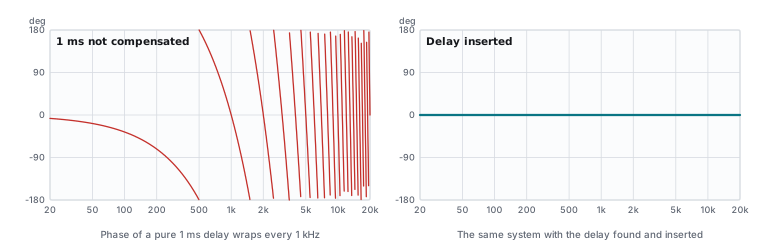
Phase is the time shift of each frequency, as a fraction of its own cycle: 360° is one cycle. The same delay is a small phase shift at low frequencies and a large one at high frequencies, so a pure delay shows as a phase line that falls more and more steeply, wrapping from −180° to +180°. That is why the analyzer first finds the travel time from the loudspeaker to the microphone (about 2.9 ms per meter) and delays the reference by it: then the phase shows the system, not the distance.
- A flat phase means all frequencies arrive together.
- A slope means some arrive later: a crossover, a filter, or parts of the system out of time.
- A 180° offset across the whole band means reversed polarity.
- Two sources add up where their phases match and cancel where they are 180° apart. This is how subs and tops are aligned.
Coherence
Coherence says how much of the microphone signal is a consistent result of the reference, from 0 (none) to 1 (all of it). It falls when something reaches the microphone that the reference does not explain: background noise and the audience, reflections arriving after the analysis window, cancellations, wind and temperature changes that move the arrival, and distortion.
The rule is simple: read magnitude and phase only where coherence is high. A peak where coherence is low may not be real, and EQ placed on it will not do what you expect. More in coherence explained.
The impulse response
The impulse response is the transfer function seen in time: what the microphone would hear if the system were fed a single click. Its highest peak is the direct sound, which is where the delay is read; the smaller peaks after it are reflections. Its polarity, up or down, is the quickest polarity check for a full-range box.
FFT size and the multi-time window
An FFT looks at a block of samples. A long block gives fine frequency resolution but reacts slowly and lets more reflections in; a short block reacts fast but cannot resolve low frequencies. Sound needs both: low frequencies have long wavelengths and need long windows, high frequencies short ones. A multi-time-window transfer function, such as PA Trace's MTW++, uses several FFT sizes at once and takes each frequency range from the window that suits it, so the resolution is roughly constant per octave across the whole band. The numbers are in FFT size and time windows.
Averaging and smoothing
- Averaging combines several measurements over time. More averaging gives a steadier trace and better coherence in noise, but reacts more slowly. Outdoors and at low frequencies, average more.
- Smoothing combines neighbouring frequencies. Read the overall balance at 1/6 to 1/3 octave, and look for narrow problems such as reflections at 1/12 to 1/24 octave.
A first measurement, in short
The hardware and routing are covered in measurement setup.
- Connect the reference and the microphone, and check both input meters.
- Place the microphone where it represents the audience the loudspeaker covers.
- Play noise or program well above the background noise, start the measurement and find the delay.
- Wait until the trace settles and the coherence is high, then capture it with a clear name.
- Read coherence first, then magnitude for balance, then phase for timing.
Next: how to tune a PA system, step by step.
Related guides
- Measurement setup Microphone, interface, where to take the reference, and the levels that make a measurement trustworthy.
- Coherence explained What the coherence trace means, what each pattern of low coherence points to, and how to raise it.
- FFT size and time windows Why one FFT size cannot serve the whole audio band, and how a multi-time window solves it.
- How to tune a PA system, step by step The order of work, from verifying the system to EQ and documentation.