 PA Trace for live sound
Coherence: how far to trust a measurement
Every transfer function comes with a third trace beside magnitude and phase: coherence. It answers one question at each frequency: how much of what the microphone heard is explained by the signal the system was sent? Read it first, and you will stop making EQ decisions on curves that are not real.
Updated 17 November 2026
What coherence is
Coherence (written γ²) runs from 0 to 1. At 1, everything the microphone picked up at that frequency is a consistent, linear result of the reference. At 0, none of it is. In between, part of the microphone signal is something else: noise, late reflections, a moving arrival.
It comes from the same averaged spectra as the transfer function. For each frequency the analyzer averages the reference power Gxx, the microphone power Gyy and the cross-spectrum Gxy. The transfer function is Gxy / Gxx; coherence is |Gxy|² / (Gxx · Gyy). Noise that has nothing to do with the reference adds to Gyy but averages away in Gxy, and that is what pulls coherence down.
Many analyzers draw the square root, |γ|, on a 0 to 100 % scale. The meaning is the same.
What lowers it
- Background noise, the audience, other sound sources.
- Reflections and reverberation arriving later than the analysis window.
- Cancellations, where little of the signal is left.
- Wind and temperature changes, which move the arrival from moment to moment.
- A delay that is not set, or has drifted.
- Distortion and clipping.
- No energy in the test signal at that frequency (a band-limited signal, or music without that note).
Read the pattern, not just the level
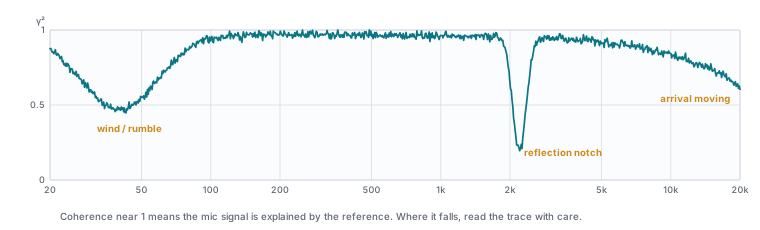
Where coherence falls tells you why.
| Pattern | Likely cause | What to do |
|---|---|---|
| Low at the bottom of the band | Wind or rumble on the microphone, air conditioning, traffic | Windscreen, more averaging, a louder signal in that range |
| Falling at the top | The arrival is moving: wind, a swaying mic, a delay that drifted | Find the delay again; outdoors average deeper and wait for calmer air |
| Low at both ends | Wind | As above, both remedies |
| Narrow holes in the middle | A reflection notch or a cancellation between two sources | Move the mic away from surfaces; check timing between sources |
| Low across the whole band | Noise about as loud as the signal | Raise the signal, average more, or measure later |
The rule
Read magnitude and phase only where coherence is high. A peak where coherence is low may not exist, and a filter placed on it will not do what you expect. A phase trace where coherence is low tells you nothing about timing. When you compare two sources at a crossover, both need good coherence in the overlap.
Polar and Complex averaging
There are two ways to average the magnitude, and they disagree exactly where coherence is low:
| Averaging | How | Behavior |
|---|---|---|
| Polar | From the averaged powers of the two signals | Reads the level a listener hears, noise included. Stays right where coherence is low. |
| Complex | Vector average of the transfer function | Leaves out noise unrelated to the reference, so it reads low where coherence is low. |
The gap between them follows directly from coherence: Polar − Complex = 10·log10(1/γ²) dB. At γ² = 0.5 that is 3 dB. So if the two differ by more than a few dB at some frequency, coherence there is poor and the reading should not be acted on. Use Polar for EQ decisions and Complex to see the system through noise.
How to raise coherence
- Set the delay. Without it the reference and microphone do not line up in time and coherence falls at the top.
- Raise the test signal until it is well above the background noise.
- Average more. A deeper average separates what the reference explains from what it does not, at the cost of a slower reaction.
- Move the microphone away from walls, tables and large objects.
- Outdoors, use a windscreen and give the measurement time.
- Use full-band pink noise, or program that has energy where you are looking.
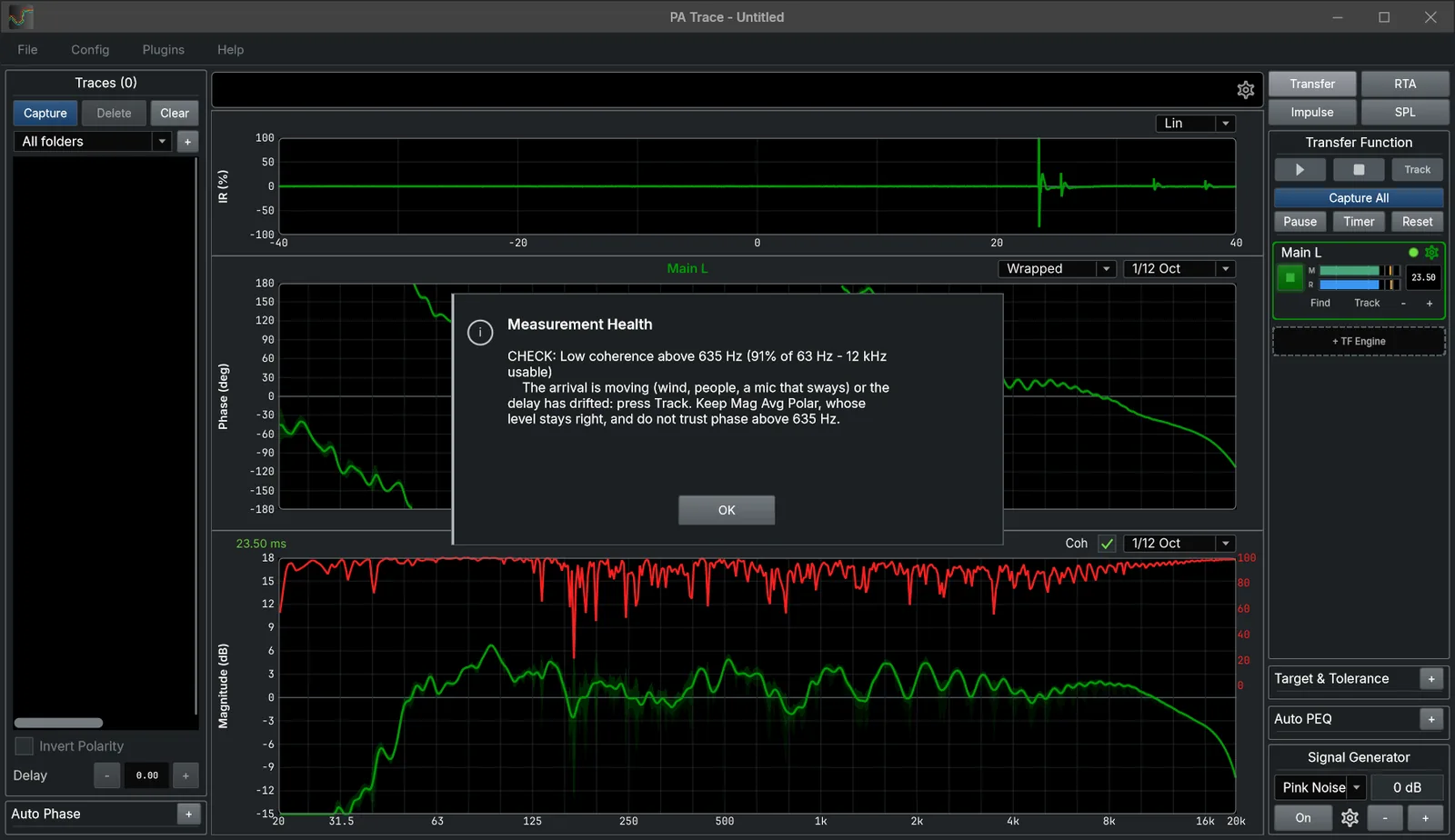
In PA Trace: the health dot on each engine turns amber or red when coherence is lost, and a click names where and the likely cause. Coh Blank hides magnitude and phase below a coherence you choose, an uncertainty band around the trace shows how far it can be from the truth, and Wind Lock lines up each frame before averaging so wind does not wash out the top octaves.
Related guides
- Transfer function measurement, explained Magnitude, phase, coherence and the impulse response: what they are and how to read them.
- FFT size and time windows Why one FFT size cannot serve the whole audio band, and how a multi-time window solves it.
- Troubleshooting No signal, low coherence, a phase that will not settle, a delay that jumps: causes and checks, quickest first.
- Delay speakers and fills Measure the arrival of each source where they overlap, delay the earlier one, and check the comb filter is gone.